Once upon a time, there was a little girl. Her name was Ella. As a young child she enjoyed her life, with her two parents in the south. Alas! God was not in their favor. Jesus took her mother away. The father, grief stricken, could not care for Ella. At once, a corrupt cluster of merchants conspired against him and told the wealthy father to go away on business. Everyone believed that they could swindle the father out of his money. Unfortunately, the group of merchants convinced the father to embark on this long and dangerous journey; Ella was left alone with the iniquitous merchants who immediately sold all of Ella's father's possessions. Ella was forced to do the house work, while the merchants enjoyed life. When Ella turned six years old, she joined the work force and left, in the secretive cover night to work in the nearby factory. From six p.m. to six a.m. Ella worked and worked, and no one heard her woes. For who can speak for the children?
Fairy tales like this often depict the child doing some hard labor and ending up like a princess in some act of luck. However, in this tale there is no ending. Ella is forced to work for the rest of her childhood. Her mother, who would be empathetic, would be able to help Ella. The father, could not help her. He can not empathize, yet he has the right to a vote, to help a nation, to help a child, but he cannot.
Synonymous with this tale, is the concept of child labor and suffrage in the 1900s. Ella represents the voiceless children who have a sliver of outreach in women's right activist Florence Kelley's speech. Kelley advocates for the children who work cruel hours in the "deafening noise" (Kelley) of a factory. These children are pressurized in conditions that no child should ever have to bear: "a girl of six or seven...may work eleven hours...while [everyone else] sleep" (Kelley). Kelley effortlessly joins the ranks defending the children. Her rhetoric connotes a sense of patriotism that gives the children a sense of freedom by using phrases like "freeing the children from toil" (Kelley). Nonetheless, Kelley uses this opportunity to recruit the throes of women in her audience for women suffrage, asserting that these abominable conditions would not happen if women had "enfranchisement..to free the children" (Kelley).
Although today this issue is less potent as it was back then, the effects have been lessened by the use of enfranchisement. By giving women the right to vote, the world has seen a more empathetic view. The pink elephants, whom were drunk, delirious and oblivious to the conditions of women and children, can now acknowledge an enlightening vision. The morale of the story: Treat people as they should be treated. Children should be treated as children, being able to roam free; women should be treated as women, just like men should be treated like men, with the right to vote.

Fairy tales like this often depict the child doing some hard labor and ending up like a princess in some act of luck. However, in this tale there is no ending. Ella is forced to work for the rest of her childhood. Her mother, who would be empathetic, would be able to help Ella. The father, could not help her. He can not empathize, yet he has the right to a vote, to help a nation, to help a child, but he cannot.
Synonymous with this tale, is the concept of child labor and suffrage in the 1900s. Ella represents the voiceless children who have a sliver of outreach in women's right activist Florence Kelley's speech. Kelley advocates for the children who work cruel hours in the "deafening noise" (Kelley) of a factory. These children are pressurized in conditions that no child should ever have to bear: "a girl of six or seven...may work eleven hours...while [everyone else] sleep" (Kelley). Kelley effortlessly joins the ranks defending the children. Her rhetoric connotes a sense of patriotism that gives the children a sense of freedom by using phrases like "freeing the children from toil" (Kelley). Nonetheless, Kelley uses this opportunity to recruit the throes of women in her audience for women suffrage, asserting that these abominable conditions would not happen if women had "enfranchisement..to free the children" (Kelley).
Although today this issue is less potent as it was back then, the effects have been lessened by the use of enfranchisement. By giving women the right to vote, the world has seen a more empathetic view. The pink elephants, whom were drunk, delirious and oblivious to the conditions of women and children, can now acknowledge an enlightening vision. The morale of the story: Treat people as they should be treated. Children should be treated as children, being able to roam free; women should be treated as women, just like men should be treated like men, with the right to vote.
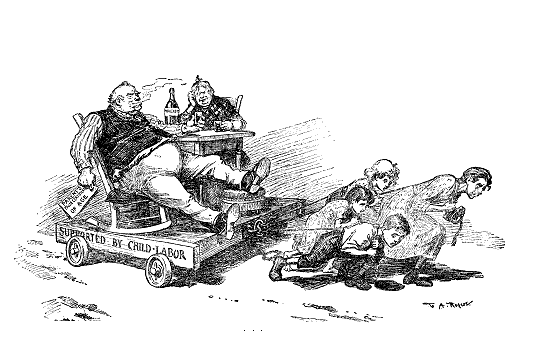

Child labor is an issue that was existent forever. In asian countries, child labor was considered obvious, expecially for boys. This was also true for many western kingdoms too. In fact, its only been the last few centuries since people have begun to recognize it as a problem.
ReplyDeleteBut I must say, Ella's story sounds quite sad. Interesting read as always.