Sunday, March 30, 2014

A Strange Shoal

When I was a little girl, my older sister brought home two fish. These Yort fish were babies, yet when they grew up, the animosity that came from such small animals provided a perplexing problem that my imaginative mind wanted to investigate. As such, every investigation begins with a background check on the victims. If you did not understand before, these two fish, a subspecies of the Y. nevele family, had somehow managed to become cannibalistic and ate each other, over the course of a few days. We did not know as we saw no evil.
These fish were nondescript and look exactly like one another, although one was a definite boy and the other a girl. While looking in through the fish bowl, one could see nothing wrong with the two. Yet, when one fed the fish, the two of them fought like mad to be the first to eat. We kept them fed, yet they kept taking bites out of the other's hide.
We once tried to separate them (because my sister was doing a behavioral study on how they would interact) but the same thing happened; even though there was no other fish they would dart around, using up almost all their energy in order to beat an unknown opponent.
So there goes the story of the two cannibalistic fish that ate each other. It has not been solved to this day and remains a mystery.
However, when looking at a school of Yort fish (the fish that reach adolescent years, like the victims) start off their day by grooming. This "grooming" usually takes about an hour and is done mostly individually; once in a while a female fish will group together with other unmated female fish and swim in a formation known as a crown. These cliques, which come from the Atlantic and Pacific Ocean and differ only in color and size, usually last for around five minutes before a dispute has the whole crowd falling apart.

The school of fish usually hunt in packs, eating whatever junk food is in the ocean. However, when they grow tired of that, they hunt the weakest link and elevate their status in the school of fish.
Now towards the beginning of the day the most unusual thing occurs; the school of fish separate into small subgroups of twenty-two and start to swim in a formation called double-crowned. It looks like two rings and these rings are often interchanged. However, the fish in the middle often spit out junk in order to improve their social status. This does not aid the group in any way, and the scientists are often baffled to why they do this. Yet this cycle goes on and on and on.
Like Horace Miner's piece, Body Ritual Among the Nacirema, this piece serves to expose the hubris located in our junior class. I do not know about your feelings, but I can tell you after careful observation and testing, that our class is the worst class in regards of helping each other. Our pride causes us to yell out above others in discussion; often we add irrelevant information to discussion and it does nothing to aide our learning. I once asked a question to another classmate and they responded with, "Sorry, I can't help you, that would be against my ethics." First off, she did actually say ethics, and second, she refused to assist me in finding the page number upon which I could read for the homework. The school of Yort fish, whom only grow up to adolescent years, show that as we mature our class has hit a ceiling: we can never grow passed it.
Even in our English class: there's always one or two people speaking only. They only speak for the participation points and really do not add anything insightful that was already inferred.
This piece was solely for showing how much the junior class places emphasis on competition and being the best. We are a strange shoal indeed; where there should be friendship there is animosity, where there should be amity in competition, there is brutality. Strange means unfamiliar or alien, and I can tell you definitively that I see aliens all around me in the form of classmates - all are trying to kill me and dominate the planet- and strange also means hard to understand - I'm as baffled as the fake scientists.

(http://www.elginpk.com/worsley1213_1/bagshaw/fisharefriends.gif - this is a gif) 

Sunday, March 23, 2014

A Modest Proposition on How to Blog

While writing a blog post I often take at least an hour to formulate and organize what I should say and how I should say it so as to not insult anyone or anything. Unfortunately this is a very late blog post and I have taken about five minutes of my time to write this, so there are bound to be grammatical errors and such. The thing I find extremely perplexing about this situation is that I was told to blog about a satirical part of society. Understandably, I have tried to use my own writing style while catering to the needs of my audience. I feel that I must propose a different plan to you, my audience, on how to blog in English class. 
Find a topic or issue you find interesting and one that has been covered in class. Next, form a question or a prompt on how to answer the question. After that, answer your question using one or two sentences. From here expand upon your own answer while adding quotes. These quotes should be no longer than two words to effectively use your derivative skills to find meaning in those two words. To simplify this even further, use descriptive words, that can be positive or negative. Then work these descriptive words into your sentence fluently so that it seems as if it is part of the sentence. Some example phrases are: The author asserted that the "blue" curtains were a symbol of the depressed mood of the "society." Never, ever begin a sentence with a quote or end a paragraph with a quote. Quote sandwiches are your "friends not food," and it is much better to end on some intelligent thought. 
Perhaps before this step, you should determine your purpose. Your purpose could be to expose, to assert (minimally), to persuade (those who are already on your side), or to enlighten (those who are are uninformed on the topic). Secondly figure out whether you stand on either side of a yes or no fence, and then proceed from here. 
Next determine your audience. In this case it is most likely our English teacher and a few friends who have actually bothered to find the follow button on your blog's main page. 
Then start writing about your two sentence response and how you really feel about the topic at the end. However, watch out as you can not be too personal or too strong in your assertions. Maybe add a concession to your piece; it may give you a higher grade to acknowledge the other side of the prompt.
In your conclusion, make sure you provide a call-to-action or a how-this-connects-to-the-real-world sentence or two. This will eventually lead you into a response about how the prompt actually goes towards a higher purpose - making you realize something about the world, society, or writing itself.  
The main goal of blogging is to organize your personal thoughts about a matter, and become more organized as a writer, without being too formulaic. This is actually how I organize my thoughts for a blog post: haphazardly and sort of formulaic. My intentions were not to be insulting or whatever maybe taken from this piece. I simply wanted to narrate the story of how I learned to blog. 

A Simple Solution


To Prevent the Government of the United States of America
from Making a Mockery of its Reputation or of the Country
and to Make Themselves Beneficial to the Public

It is a sad thing to those who travel through this great country, when they see the streets, the roads, and the squares, crowded with citizens from all walks of life, followed by three, four, or six protesting posters, all in different colors and importuning every passerby for support. These citizens, instead of being able to work for a greater good, are forced to expend all their time in circles and crowds protesting for "their rights."
I think it is agreed by all parties that this prodigious number of people, gaudily painted, are representing the deplorable state of our country. Therefore whoever can find a suitable means to meet both sides' objectives might become a hero worthy of praise.
As to my own part, having thought on this for a whole five minutes about this important subject, and maturely weighed the virtues of several plots, have found that most are inane and mistaken in their expeditions. The uselessness of protesting can be seen to be inadequate in a system that grants no one support. However, I neither you, can distract them from their "higher purpose." I propose to not only solve this excruciating problem, but also, on the contrary to contribute to the feeding, nurturing and partly to the helpful of the many thousands of medial and imperial influences.
I shall now humbly propose my own thoughts on this important subject, which I hope will alleviate the pain of the subject of protestation against the United States of America.
I have been assured by a very knowing and intelligent child of my acquaintance in Whoknowswhere, that by focusing the media on the whereabouts of our governments' incursions and subjugation is a successful way to confuse the people about their protestations. Therefore eliminating all these noisy and inhumane mobs that argue for the right of the people. I do therefore humbly offer this to congressional consideration that of the hundreds of infringements of rights that they have committed be hereby voided and in return venture into the nearest warring country to offer support for "their democratic rights." By doing so the government can successfully turn the protests for rights and the caustic infringement upon the fifth to a galvanization of support for the soldiers abroad.
This is a touchy subject understandably as Congress cannot be in agreement for more than two minutes at a time before erupting into some scandal. The elected "Representative" of the outer borders can at times be mold-able and easily "influenced" to agree to such a cause as eliminating the amount of outcry for justice regarding infringement on rights.
By using the media to cover up scandals and other American misdeeds, Congress can increase its influence in other parts of the world. This is especially beneficial because in similarity to the communists, spreading our country's ideas can ensure that they last for the ages to come.
Secondly, by influencing the media and other areas of reading, Congress can in turn expand the reach of Democracy. By using the media, which reaches all corners of the world, Congress can more easily convince the diverse people of the world that their views are wrong and America's views are the best.
Thirdly, by promoting wars in other countries, the United States can foster their own economy. By taking "influences" from corporations and other "homeland defense" companies, the economy can grow. When the slightly monopolistic corporations control most of the arms market little is in their way from controlling the entire market and subsequently the government. However Congress can prevent this last point by increasing its pay and decreasing the pay of soldiers. This will not only solve the problem of corporate takeover of the government but also in turn protester's energy would be allocated elsewhere towards bring the troops money, supplies, and food.
Although this would cause the three branches of the government to become unequal, shifting power, this would cause there to be one supporting branch that can mediate the other branches. This is a much better solution because Congress, the Executive and Judicial branches have never ever been in agreement whatsoever since 1776, and even then there was minimal agreement.
Also by invading and purposefully embargoing countries, the United States can do nothing to influence its ideas. It should instead take the advice of previous chair holders and possibly redo the affairs that introduced the Iran-Contra and the CIA–Al-Qaeda controversy. Especially Al-Qaeda controversy, which received American funding to fight against the Soviets, who mind you were going against American ideals, and then in turn ending up fighting against the American ideals itself. This prompted the United States to invade in an attempt to fix the problem that it created.
This is a prime example of how the United States successfully employed my proposal. By discretely starting another war, the United States brought attention to the reaches of Soviets and in turn eliminated the homeland threat of the NSA, which in 2001 began its domestic spying, when the US cut off the CIA from training the Jihad.
I profess, in the sincerity of my heart, that I have not the least personal interest in endeavoring to promote this necessary work, having no other motives than the public and worldly good of my country, by advancing our influence, providing for an increase in governmental reaches, relieving the public of its interest on their personal rights, and giving pleasure to the representatives and corporations. I have no ideas besides those of Patriotism by which I can propose to benefit from this; the most of my ideas have been given to me by the best government and I feel simply satisfied.

Works Cited: Swift, Jonathan. "A Modest Proposal." Bedford/Martin's. ed. 3. 2014

Sunday, March 16, 2014

100,000 Stars of Appreciation

Science began as a risk: trying to find out the unknown. Seeking the unknown has lead to devastation as well as appreciation. Chet Raymo, in his piece, A Measure of Restraint, focuses on the negative effects of "the human quest for scientific discovery." However perilous this journey must seem, it is a necessary evil. Chet Raymo illustrates "the risks that are sometimes imposed by knowledge," and various examples that add to his pathos. Although he does not necessarily condemn the human search, he expresses his attitude of "self-restraint," and how scientists lack these skills, especially with his characterization of the seemingly useless glowing tobacco plant.

Yet, throughout his piece Raymo makes remarks about the "luminous" qualities of these scientific discoveries. He sheds a harsh light on these grandiose experiments, yet I can not help but feel he is in slight awe of these discoveries: "hardly know[ing] how to react." These discoveries "of cold brilliance" still have an effect on him in a slightly positive way.

Last year I tried to write a research paper on nuclear power. At first I was under the impression that nuclear power was extremely bad as it could be used for destructive means. This sort of one-sided thinking goes along with the message Raymo is trying to convey: caution and restraint over science. Not once does Raymo think of the good deeds of science that are often gone unappreciated.

Science has saved the rain forest. Science has given life to the animals. Science has taken us to the stars. Science has taken away the grit and dirt in our eyes and enlightened our world.

I am often reminded of the power of science through this: 100,000 Stars (link to a Google chrome website-best used with chrome). The power of simple graphics and imaging gave me passage to a higher knowledge at my fingertips. I can roam the stars and gain information. There is no risk here. No devastation. Not to me at least. I appreciate it instead.

Raymo talks about the fine line between risk and science. I think both are intertwined: without one or the other neither would happen. Without risk the first caveman would not have created a rock with a circle and called it a wheel, nor would we have the distance of the stars to contemplate.

Sunday, March 9, 2014

Fairly Reality Tale

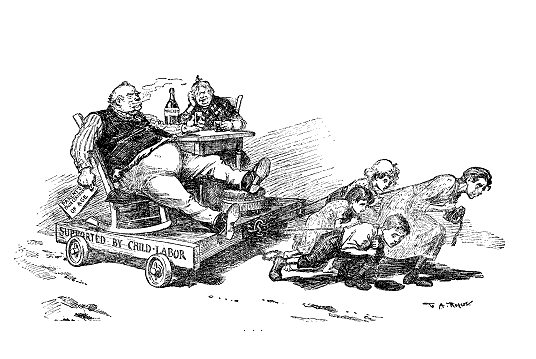
Once upon a time, there was a little girl. Her name was Ella. As a young child she enjoyed her life, with her two parents in the south. Alas! God was not in their favor. Jesus took her mother away. The father, grief stricken, could not care for Ella. At once, a corrupt cluster of merchants conspired against him and told the wealthy father to go away on business. Everyone believed that they could swindle the father out of his money. Unfortunately, the group of merchants convinced the father to embark on this long and dangerous journey; Ella was left alone with the iniquitous merchants who immediately sold all of Ella's father's possessions.  Ella was forced to do the house work, while the merchants enjoyed life. When Ella turned six years old, she joined the work force and left, in the secretive cover night to work in the nearby factory. From six p.m. to six a.m. Ella worked and worked, and no one heard her woes. For who can speak for the children?

Fairy tales like this often depict the child doing some hard labor and ending up like a princess in some act of luck. However, in this tale there is no ending. Ella is forced to work for the rest of her childhood. Her mother, who would be empathetic, would be able to help Ella. The father, could not help her. He can not empathize, yet he has the right to a vote, to help a nation, to help a child, but he cannot.

Synonymous with this tale, is the concept of child labor and suffrage in the 1900s. Ella represents the voiceless children who have a sliver of outreach in women's right activist Florence Kelley's speech. Kelley advocates for the children who work cruel hours in the "deafening noise" (Kelley) of a factory. These children are pressurized in conditions that no child should ever have to bear: "a girl of six or seven...may work eleven hours...while [everyone else] sleep" (Kelley). Kelley effortlessly joins the ranks defending the children. Her rhetoric connotes a sense of patriotism that gives the children a sense of freedom by using phrases like "freeing the children from toil" (Kelley). Nonetheless, Kelley uses this opportunity to recruit the throes of women in her audience for women suffrage, asserting that these abominable conditions would not happen if women had "enfranchisement..to free the children" (Kelley).

Although today this issue is less potent as it was back then, the effects have been lessened by the use of enfranchisement. By giving women the right to vote, the world has seen a more empathetic view. The pink elephants, whom were drunk, delirious and oblivious to the conditions of women and children, can now acknowledge an enlightening vision. The morale of the story: Treat people as they should be treated. Children should be treated as children, being able to roam free; women should be treated as women, just like men should be treated like men, with the right to vote.


Sunday, March 2, 2014

Its Stereotypical

"A widely held but fixed and oversimplified image or idea of a particular type or person or thing." I think whoever sat at their computer all day in Google headquarters was trying to be intelligent about this word, especially since he used "or thing" at the end - almost as if he wanted to not sound horrible. But it is true. A stereotype is a known notion of a person. There's no going around it. People immediately see a person and think, "Huh, they must be a ______." If an image can hold a thousand words, how much can a three-dimensional person be described in? Apparently, just one word.

Stereotype actually is a Greek word. Stereos, meaning firm and solid, and typos, meaning impression. So it actually means solid impression. How can one person have a solid opinion based on how someone looks or acts? Of course critics may argue that after you see someone, you can understand their basic motions and classify them as a white chick, a bumpkin, a nerd, etc. But in those first few seconds of knowing, you can form a firm opinion of them? I call that jumping to conclusions. 

The need to jump to conclusions stems from the individualism we futilely seek. We see a need to express ourselves as different. Stereotype, at first, was used to describe a copy of an original typeset. So, if this word was used to describe people, does society copy itself? Well, we are all humans, copying is in our nature. We use mimicry to distinguish ourselves from the next person. We mimic the people around us, drawing in on their subtle ways and outer appearance. Just take for example, the models we so strive to be. We wear their clothes in hopes of becoming like them. However, our outer appearance is based on making ourselves individual. Body image does so much to enhance our sense of individualism - so that we don't feel classified. The clothes we wear, the makeup we put on, the words that come out of our mouths. It all gives to our individuality. These tools were created so that we could each see each other as individuals - a puzzle that needed solving. Yet, these tools are contradicted wholly by the word stereotypical. Typically, we crave independence from such norms. We crave to be something that can not be defined by society. We crave to be a singular entity. We crave to be different from each other. How can we crave something that is just an illusion? To be an individual is an illusion. Society groups us into categories; we can't escape. Even if you change your colors, society will throw you into another holding cell - the one you mimicked. 

I can say with first handedness that I have seen this mimicry in action. As a child I never really paid attention to the time at the airports before trips. The security line seems like a really objective place right? Random searches done every few people or so. I never really paid attention when my dad or mom would get called out of the security line for a random search. But they grew more and more frequent with my dad. My dad is what you would say is a causal dresser. Early 2000s, he wore the worn out jeans with holes and T-shirt proudly. His typical Indian sandals were time savers in the security lines. His messy long hair and glasses with black eyes staring out defiantly were his characteristics. Little did I know that he was being taken as a possible threat. My dad, who they barely said two sentences to, was a threat. He didn't even have the most stereotypical justification to the searches - visits to the Middle East. They just, based on sight alone, profiled him. I think that's the nicest word for stereotyping: profiling.

Profiling may be a euphemism for stereotyping but it still hurts. Stereotyping makes it so that we "feel like an accomplice in tyranny" (Staples). We are divided into the many groups a kingdom has: wench, country lad, merchant, etc, but "we'll never be royals" (Lorde/Little), no matter how much we try to mimic them. This innate need to show ourselves as different has led us to the word stereotypical. We are just copies of someone else, someone we strive to be.


"Can you not tell me that within the first few moments of knowing each person in this room, you had not formed firm judgments of their character, which up to this very moment, you have not questioned?" 
~Nobley, Austenland, Shannon Hale